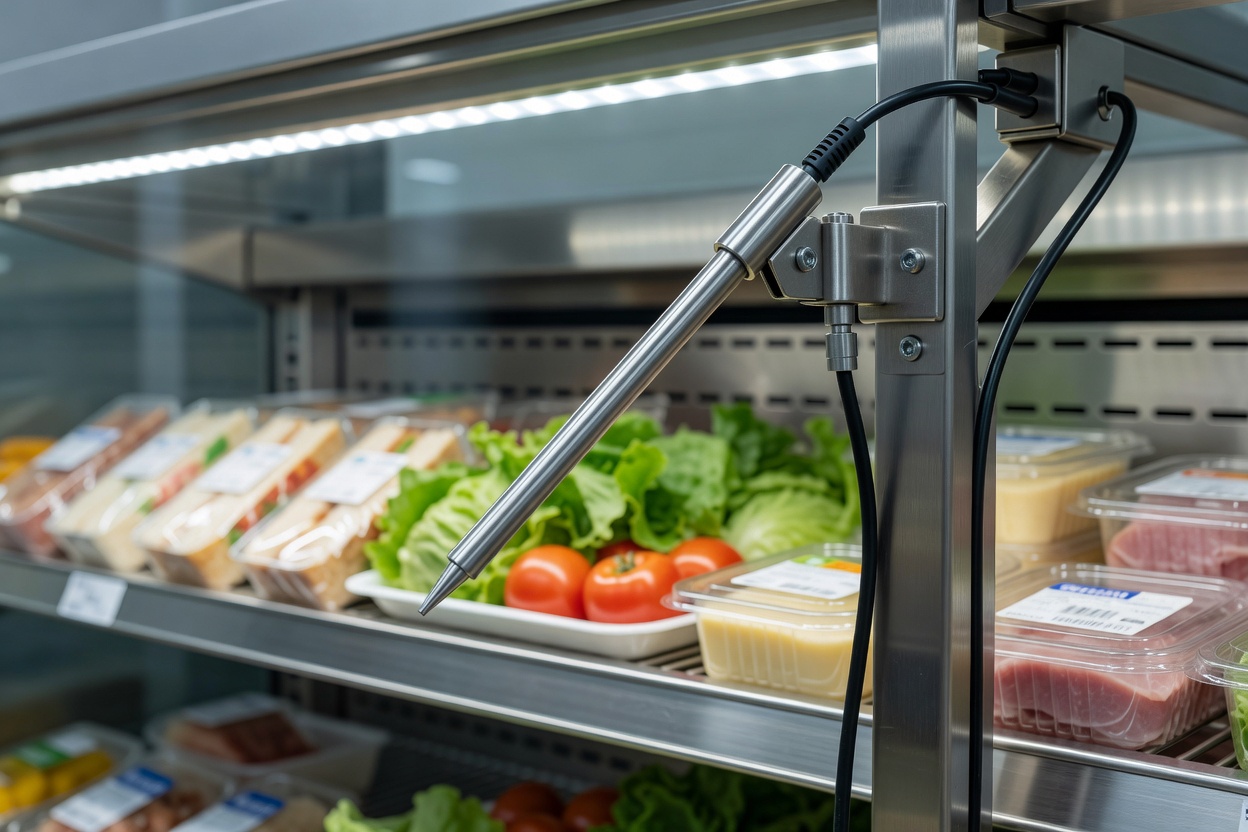
 PROBE POSITIONING
Understanding Temperature Observation in Grocery Retail
Temperature monitoring is the foundation of supermarket cold-chain management. In retail food environments, different products require specific thermal bands—from fresh meat and dairy held at chilled temperatures to ice cream held at deep-frozen levels. Because exact regulatory thresholds and product tolerances vary significantly by jurisdiction, product category, and regional food authority, monitoring systems should be configured around site-specific quality guidelines rather than arbitrary universal assumptions.
Sensor Placement Concepts
Where a temperature probe is positioned determines what physical phenomenon it actually measures. A common error in grocery setups is placing a probe in a dead air pocket or directly under an internal spotlight.
Discharge Air (Air-Off) Probes
Positioned immediately downstream of the evaporator coil in the air discharge duct or honeycomb. This reading indicates the lowest temperature the circulating air reaches and serves as an indicator of coil cooling performance.
Return Air (Air-On) Probes
Placed where air enters back into the bottom or rear of the display case after circulating over product shelves. This temperature reflects the thermal load picked up from ambient store air and stored goods.
Product Simulant Probes
Sensors encased in thermal buffer blocks (such as food-grade glycol or nylon blocks) that mimic the thermal mass of food items. These prevent short-term transient air spikes (e.g., during door openings) from triggering unwarranted alarms.
Data Logging Frequency & Consistency
The frequency of data capture directly impacts operational analysis. Modern digital controllers log temperatures at intervals ranging from 1 to 15 minutes:
- High-Frequency Logging (1–5 min): Ideal for commissioning, detecting short-cycling compressors, or observing rapid defrost recovery curves.
- Standard Operational Cadence (10–15 min): Balances database storage overhead with granular historical tracking suitable for long-term trend analysis.
Identifying Unusual Readings & Thermal Drift
Thermal drift is the slow, progressive elevation of average case temperatures over days or weeks. While sudden power failures trigger immediate alarms, subtle drift often escapes notice unless historical plots are analyzed. Common underlying causes include:
- Gradual accumulation of lint and dust on condenser surfaces.
- Partial refrigerant loss causing a drop in suction pressure and reduced cooling capacity.
- Degrading magnetic door gaskets allowing moist ambient air infiltration.
- Overstocked shelves blocking the return air intake grilles.
Escalation & Maintenance Coordination
When anomalous temperatures are recorded, structured escalation workflows ensure that store colleagues and service engineers coordinate effectively:
- Initial Threshold Breach: The system logs an out-of-spec reading and initiates a timer to filter out expected defrost cycles or routine restocking door openings.
- Persistence Verification: If the reading remains elevated beyond the defined buffer period, an alert is routed to on-duty store team leaders for a visual check (e.g., verifying doors are closed and air grilles are clear).
- Technical Dispatch: If physical checks do not resolve the reading within the scheduled operational window, a ticket is logged with the contracted refrigeration maintenance team.
Learn About Display Cases & Cold Rooms
Discover how cabinet airflow design, door seals, and evaporator maintenance maintain proper temperatures across your sales floor.